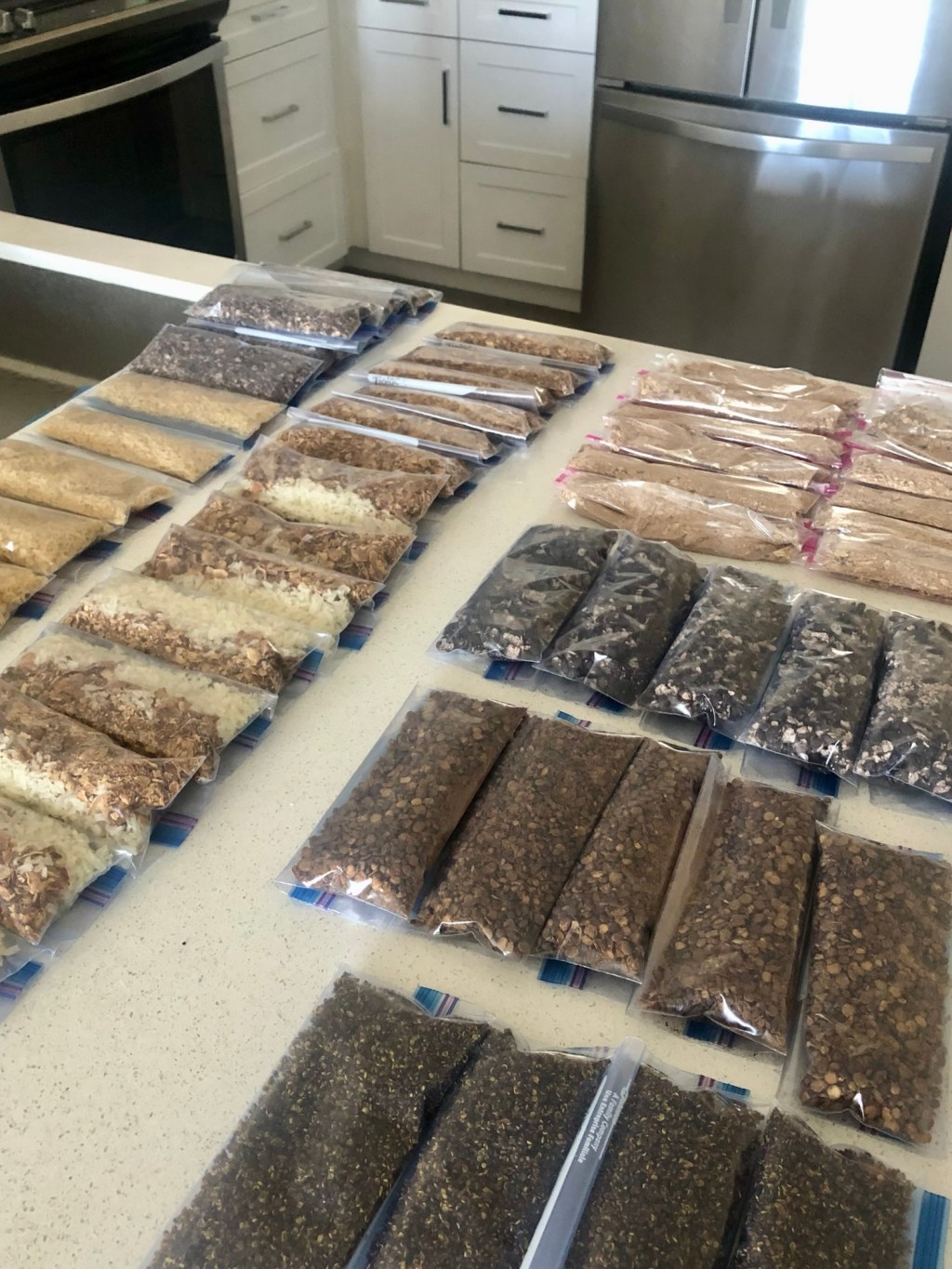
While delicious food is essential, a successful thru-hike depends on a resupply strategy. Keep in mind that logistics can vary slightly depending on the trail—my approach is adaptable, but each trail has its own unique demands. For me, the AT was the easiest to plan due to its frequent towns, which allowed me to resupply my snacks every 2-3 days in most sections and make most of my resupply decisions on the trail. In contrast, the PCT and CDT often have much longer stretches between resupply points, requiring a more rigid planning approach. Here’s how I plan and execute my logistics to ensure I always have the plant-based fuel I need, wherever I am.
Resupply & Town Stop Logistics
Resupply Boxes
My resupply strategy as a vegan thru-hiker is a complex but highly reliable system involving multiple bounce boxes that ‘leapfrog’ each other down the trail.
- Box Contents & Duration: Each bounce box is packed with enough homemade meals, snack bars, and breakfasts for several weeks. I focus on packing items I can’t typically find in trail towns, with one box usually containing about three-four weeks of food.
- The ‘Leapfrog’ System: I use two bounce boxes at a time, leapfrogging them ahead down the trail—always sending the next one two stops ahead of me. This system is designed for maximum flexibility, serving as a crucial contingency in case my daily mileage changes from my calculations at home. This ensures a box is always waiting for me and prevents any delays.
- Gear Flexibility: A key benefit of mailing a resupply box from the trail is that it allows me to store or ‘bounce’ gear I don’t need for an upcoming section keeping my pack lighter.
- The In-Town Process: When I arrive in a town, I first pick up the bounce box that’s waiting for me. I then calculate the exact number of days of food I’ll need for the next section and repack the bounce box itself, adding any gear I don’t need and additional snacks I’ve picked up in town. Finally, I pack my food bag with just enough food for the upcoming section, plus an extra half-day to a full day of food as a safety net. This buffer ensures I never have to push a huge mileage day while starving just to reach town due to an unforeseen drop in my daily miles.
- Mailing Method: I rely on a friend who is in charge of my boxes back home to send the next round of bounce boxes ahead when needed. For the mailing itself, I find that large flat rate boxes from the post office are perfect for this system—they’re efficient and predictable. If needed, I’ll downsize to a smaller box to save money on shipping before bouncing it ahead.
- Meals vs. Snacks: While all my meals are pre-planned and sent in the boxes, I buy most (but not all) of my snacks in town. This allows me to be spontaneous and adapt my calories as my appetite changes.
Navigating Trail Towns
Navigating trail towns as a vegan can be a challenge, so a little planning goes a long way.
- Scout Ahead: Before I get to a town, I always research the resupply options to see if there’s a grocery store. This helps me plan ahead in case I need to add more snacks to my bounce box.
- Go to the store first: My town day routine always starts with a visit to the grocery store before heading to the post office. This allows me to grab something to eat immediately, see what’s available, and make an informed decision about what to take from my bounce box.
Planning & Navigation
While your feet do the walking, your hike is planned with the help of powerful digital tools….for everything from mileage calculations to resupply logistics.
- Navigation App: Once on the trail, my primary navigation tool is the FarOut app (it will always be Guthook to me). With its detailed maps, water sources, and comments from other hikers, it’s a one-stop shop for almost everything you need to know about a trail, making it indispensable for real-time decision-making.
- Halfway Anywhere: This website is a fantastic resource for data-driven hikers. It offers resupply guides and logistics information, but it’s most famous for its comprehensive annual gear surveys, which provide invaluable insights into the gear choices of other hikers. You can find it here: Halfwayanywhere
- Planning the PCT: While many planning tools for the PCT have emerged, Craig’s PCT Planner is the original spreadsheet-based planner I have always relied on. It’s an invaluable tool for visualizing your itinerary and calculating resupply points. You can check it out here: Craigs PCT Planner
- Planning the AT: The Postholer planner is another great tool for visualizing your hike and planning resupply. You can find the planner here: A.T. Postholer Planner
- Planning the CDT: The Postholer planner is also a great resource for this trail. You can find that planner here: CDT Postholer Planner
This resupply strategy is particularly crucial for a vegan thru-hiker, as finding reliable plant-based options in small trail towns can be a major challenge compared to what’s available for non-vegan hikers. Relying on a resupply box not only guarantees you have the plant-based fuel you need, but in my experience, it’s also a great way to save money and ensure you’re eating healthier on the trail. Ultimately, these logistics are the backbone of a successful vegan thru-hike, allowing you to focus on the trail and the experience itself. With your resupply and planning sorted, you’re free to embrace the challenges and joys of life on the trail. Remember, the best plan is a flexible plan, because things tend to not go as planned on the trail!
What’s the one thing you can’t live without in your resupply box?
Keep on trekking, y’all – Fugitive
 Dash & Dirt
Leave a comment